

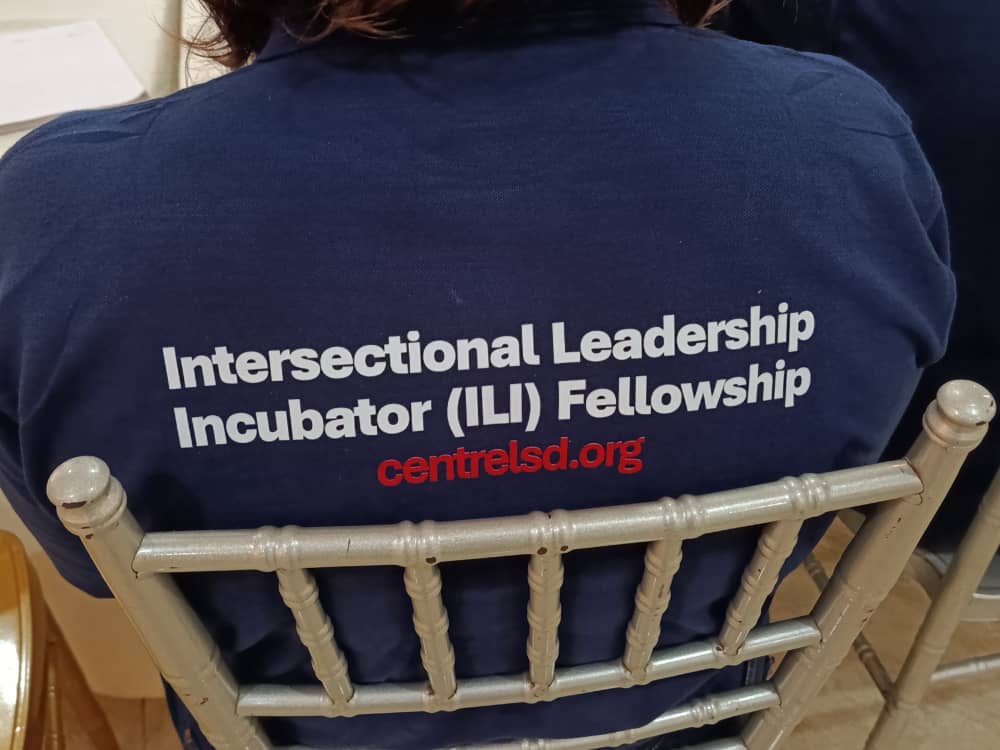
Ughelli –The stories were deeply personal, the tone reflective, and the lessons unmistakable. From Cross River to Bayelsa, Anambra to Abia, Fellows of the Intersectional Leadership Incubator (ILI) Fellowship gathered in Ughelli on Monday to share how six months of leadership training have reshaped their outlook on service, advocacy, and community engagement.
The session, aptly titled “How ILI Changed Me”, was part of Day 1 of the Fellowship’s close-out ceremony organised by the African Centre for Leadership, Strategy and Development (Centre LSD).
‘The Resilience in Me Increased’
For Light Nwosu, who implemented her gender-advocacy project between Lagos and Port Harcourt, the Fellowship was both a mirror and a motivator.
“Nothing really changed about me because when you’re into advocacy, you’re naturally a leader,” she said with a smile. “But the resilience in me increased.”
Light recounted a sensitisation visit to a secondary school where she confronted deep-seated gender bias among pupils. “The boys could not understand why a girl’s voice should be heard,” she recalled. “Convincing them made me realise there’s still so much work ahead.”
Finding Courage in Community
From Abia state, Comrade Henry Okebugwu Nwaigwe told how ILI training gave him confidence to engage traditional authorities.
“When I returned home, I discovered I had the power to face my people,” he said.
The moment that changed him most was standing before his Council of Chiefs, explaining his community project.
“My traditional ruler asked if I truly had this capacity. I said yes. That gave me special respect.”
Turning Knowledge into Action
For Chidubem Godfrey Nwachinemere of Anambra state, the Fellowship sparked an environmental initiative that outgrew his expectations.
“We produced a book on composting,” he said proudly. “I thought people wouldn’t turn up, but they came, sat down—even kids were learning and cutting cartons to produce different things.”
The enthusiasm, he added, “kept me awake all night after I saw Centre LSD post my project online.”
Hope for the Excluded
Perhaps the most touching story came from Grace Wilson of Akwa Ibom state, whose project profiled persons with disabilities for inclusion in next year’s PIA Empowerment Programme.
“Two of them knelt down and said, ‘It has never happened before that anybody considered me for anything,’” she recounted, her voice breaking slightly. “The joy and hope I saw in them gave me serious satisfaction.”
Changing Mindsets, Building Momentum
Other fellows echoed similar transformations. Joseph Anana from Cross River spoke of reconnecting with rural women farmers, while Ogbogene Joy from Bayelsa said the training made her rethink how she uses social media:
“I see myself not just as a leader but as an agent of change,” she said.
From Edo, Jennifer Godwin described how transparency learned through ILI earned her trust in a once-divided community:
“Now, every small thing they say, ‘Call Mrs Jennifer Godwin—she can echo it.’”
Beyond Titles, Toward Service
Summing up the sentiment, Grace Bassey of Cross River noted that the Fellowship shifted her perception of leadership itself.
“Before now, I thought leadership was about position,” she admitted. “I’ve come to realise it’s about service to humanity.”
Her consistent social media updates on her farming project later drew Health of Mother Earth Foundation to Bakassi, which trained more than 250 farmers on organic pesticide production—an outcome she called “proof that visibility births opportunity.”
A Ripple of Change
According to Centre LSD’s Executive Director, Mr Monday Osasah, the reflections affirm the Fellowship’s goal of creating intersectional leaders who merge advocacy with practical community solutions.
“Each fellow becomes a multiplier,” he said, “taking what was learned in Ughelli to villages, schools, and policy spaces across Nigeria.”
As Day 2 of the close-out ceremony continues, one theme is unmistakable: the ILI Fellowship didn’t just build projects—it built people.