


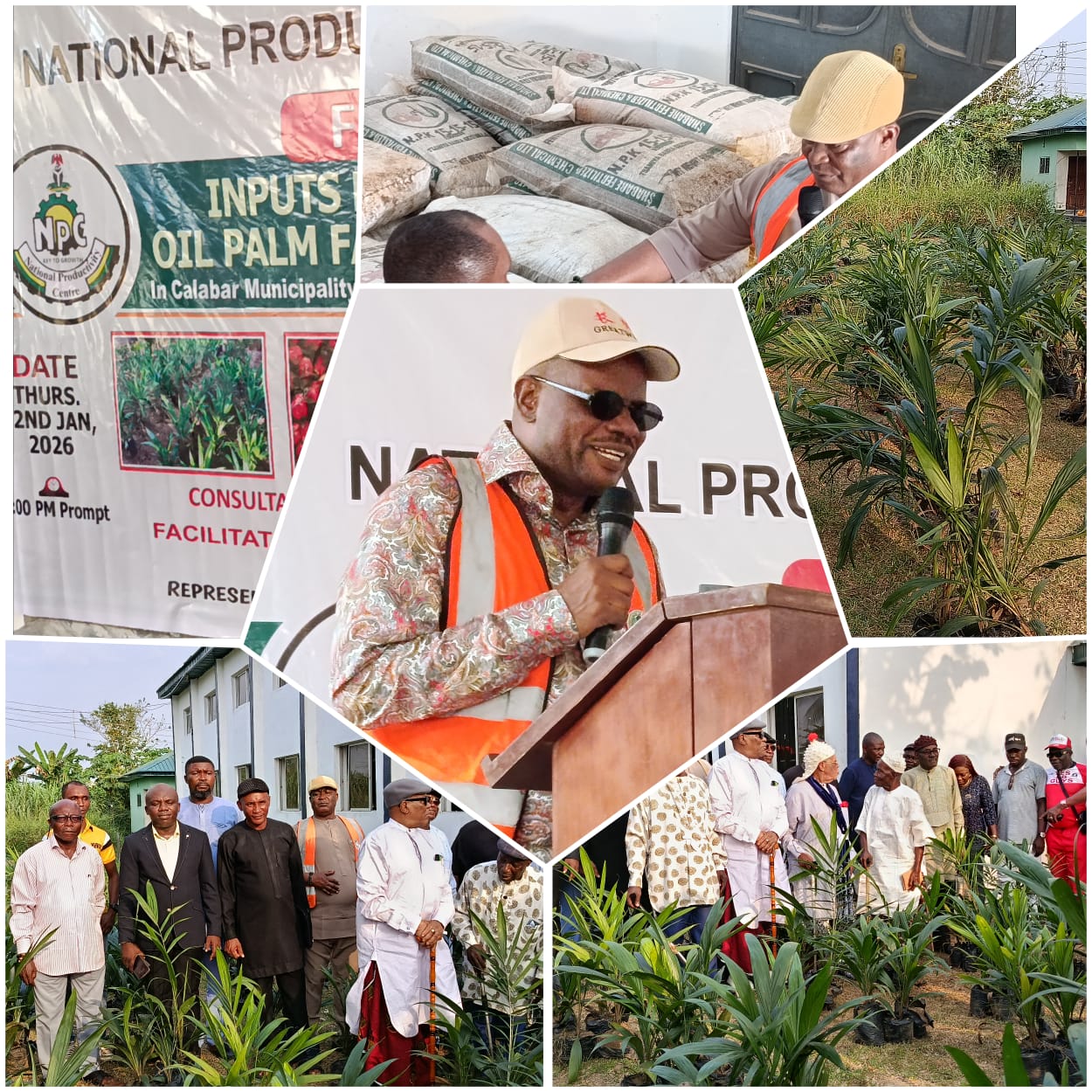
The Member representing Calabar Municipality/Odukpani Federal Constituency in the House of Representatives, Hon. Bassey Akiba, on Thursday defended his cooperative-based approach to constituency engagement and livelihood support, amid criticisms questioning the effectiveness of the strategy NEGROIDHAVEN can tell.
Akiba spoke during the flag-off of Phase II of the Input Distribution for Oil Palm Cooperatives in Odukpani Local Government Area, Cross River state, an event facilitated through the National Productivity Centre, Abuja.
Responding to questions from journalists on why he chose to work largely through cooperatives, the lawmaker said the model was deliberately adopted to strengthen representation, improve engagement with constituents and ensure structured delivery of support programmes.
He explained that during his campaign, he outlined five priorities for his tenure, three of which relate directly to his constitutional responsibilities of lawmaking, representation and oversight. According to him, the remaining two focus on continuous engagement through communication with constituents and the establishment of economic structures at the grassroots.
Akiba said he opted to organise constituents along polling-unit-based cooperatives, describing each polling unit as a “mini-community.” He disclosed that his federal constituency comprises 496 polling units, all of which have been structured into cooperatives, alongside additional groups such as women, youth, elders and faith-based associations, bringing the total to about 500 organised groups.
According to the lawmaker, critics often focus on only one aspect of the cooperative model, particularly its role in economic empowerment, without considering its broader functions.
“The cooperative structure was designed to handle representation, mobilisation and livelihood support,” he said, adding that the model has helped him engage thousands of constituents without logistical difficulties.
He cited a town hall meeting held at the Cultural Centre in Calabar, which attracted over 4,000 participants, as an example of how the cooperative system has improved mobilisation and communication.
On the economic empowerment component, Akiba acknowledged that the programme was still a work in progress. He said about 40 per cent of the planned cooperative funding and capacity-building targets had been achieved, including registration, certification and training of cooperative leaders.
He revealed that the long-term goal is to provide at least ₦1 million in support to each cooperative, translating to an estimated ₦500 million overall. However, he attributed delays in full implementation to funding constraints and budgetary challenges at the national level.
Despite the setbacks, Akiba maintained that cooperatives have already enabled the distribution of agricultural inputs, small grants and other support items to thousands of constituents, including vulnerable persons who may not have direct access to his office.
He said the ongoing oil palm input distribution, as well as planned support for cassava, fisheries and poultry cooperatives, forms part of efforts to gradually strengthen livelihoods while working towards full funding of the cooperative scheme.