


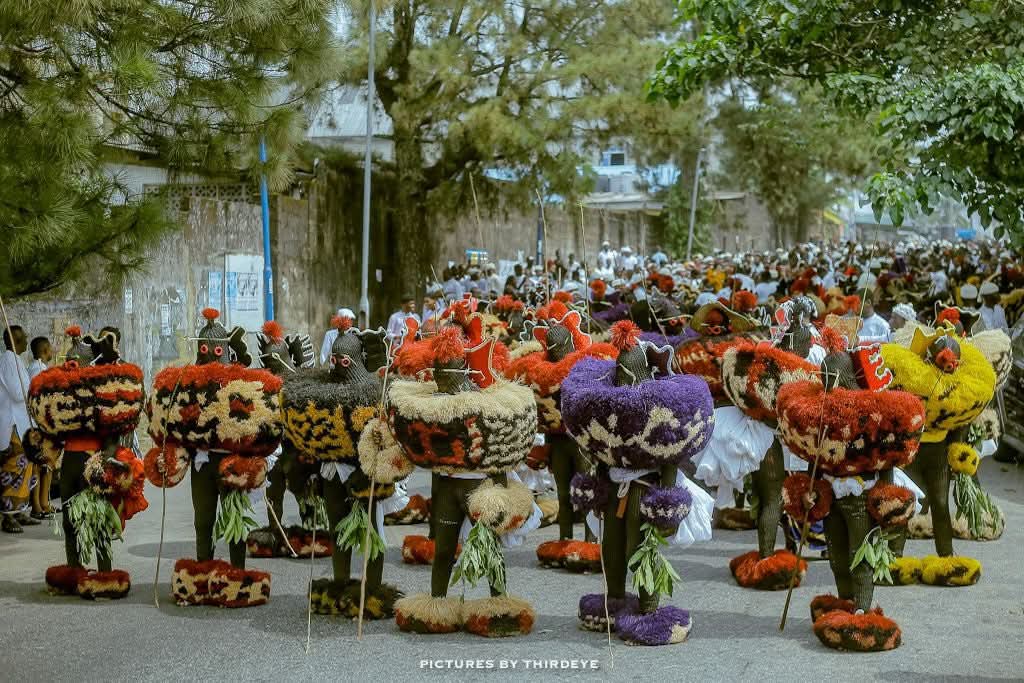
What we are dealing with in Calabar is often misunderstood because people collapse two distinct but related ideas into one. There is Carnival Calabar, and there is the Calabar Carnival. They are not the same thing, and treating them as such is where many of the errors begin.
Carnival Calabar refers to the modern, state-driven carnival project that takes place in Calabar. It is a contemporary cultural product, consciously modeled after global carnival traditions particularly those of the Caribbean, Brazil, and Europe. This version of the carnival, launched officially in 2004 under the Donald Duke administration (his wife’s idea), was designed as a tourism and branding strategy. It already has national recognition and has steadily gained international visibility. In that sense, Carnival Calabar is an imported carnival framework, adapted to local realities.
The Calabar Carnival, however, predates Carnival Calabar by centuries. It is the carnival of the Calabar people. It is rooted in indigenous performance traditions masquerades, processions, ritual theatre, costume symbolism, dance, music, and communal storytelling. What played out recently in the “Nkot Mbok” aligns more with this indigenous tradition. Events such as the Nyoro Ekpe, Leboku festival, masquerade displays outings 25th December by Nkas, ancestral processions, Utomo performances, and other ritualized spectacles belong squarely to the Calabar Carnival tradition.
Historically, Calabar has always functioned as a natural theatre. Long before modern carnivals, the Efik, Efut, Ejagham, Ugep peoples practiced elaborate public performances tied to spirituality, governance, rites of passage, and seasonal cycles. Institutions like Ekpe, for example, were not merely cultural displays but complex socio-political systems with performance at their core. Costumes, masks, colors, and movement were not aesthetic accidents they carried meaning, hierarchy, and history.
This is why the argument that “everything should be moved to the Cultural Centre” or removed entirely from the Carnival Commission framework is overly simplistic. The Cultural Centre and the Carnival Commission should not compete; they should collaborate. The Cultural Centre safeguards authenticity and historical integrity, while the Carnival Commission understands scale, commercialization, tourism, and global visibility. One preserves meaning; the other builds markets.
It is important to recognize that while Carnival Calabar has a face already on the national and emerging global stage, the Calabar Carnival is the real cultural export. When foreign visitors Europeans, Americans, Caribbeans come to Calabar, they are often more fascinated by the indigenous masquerades, costumes, and ritual theatre than by the imported carnival aesthetics. This mirrors what happens globally;people travel to Japan for Kabuki and Noh, to India for Sanskrit theatre, to Brazil for Afro-Brazilian ritual performance, to Mexico for Day of the Dead not because these are modern inventions, but because they are rooted traditions.
Ironically, many of the carnivals we admire today Caribbean carnivals included are themselves products of African ritual performance, recontextualized through history. What we imported back was a version of what originally left Africa. What we now possess, especially in Calabar, is an opportunity for cultural re-exportation.
If properly developed, the Calabar Carnival can generate value through; High-end costume design and fabrication, Miniature masks and symbolic artifacts for cultural tourism, Structured masquerade performances for global festivals, Cultural education that promotes religious tolerance and understanding of symbolism, rather than fear or misinterpretation.
Calabar sits on one of Africa’s richest cultural foundations. It exists within a region associated with some of the oldest continuous languages and performance traditions in West Africa, including Efik, whose influence once stretched across trade routes and diplomatic networks in the Gulf of Guinea.
From an economic standpoint, this conversation is critical. Cross River State does not have the luxury of diversified revenue streams. Beyond agriculture and ecotourism, culture remains one of the strongest yet underutilized economic assets. Treating this issue as a casual social media debate does injustice to its depth. This is an intellectual discourse, a cultural policy discussion, and an economic strategy conversation.
The Carnival Commission must therefore retain oversight, but in deliberate alignment with the Cultural Centre, so that commercialization does not dilute authenticity. After all, it is a carnival but, carnival with history, meaning, and economic potential.
And that distinction matters.
Otuekong Offiong Andem Bassey writes from the UK