


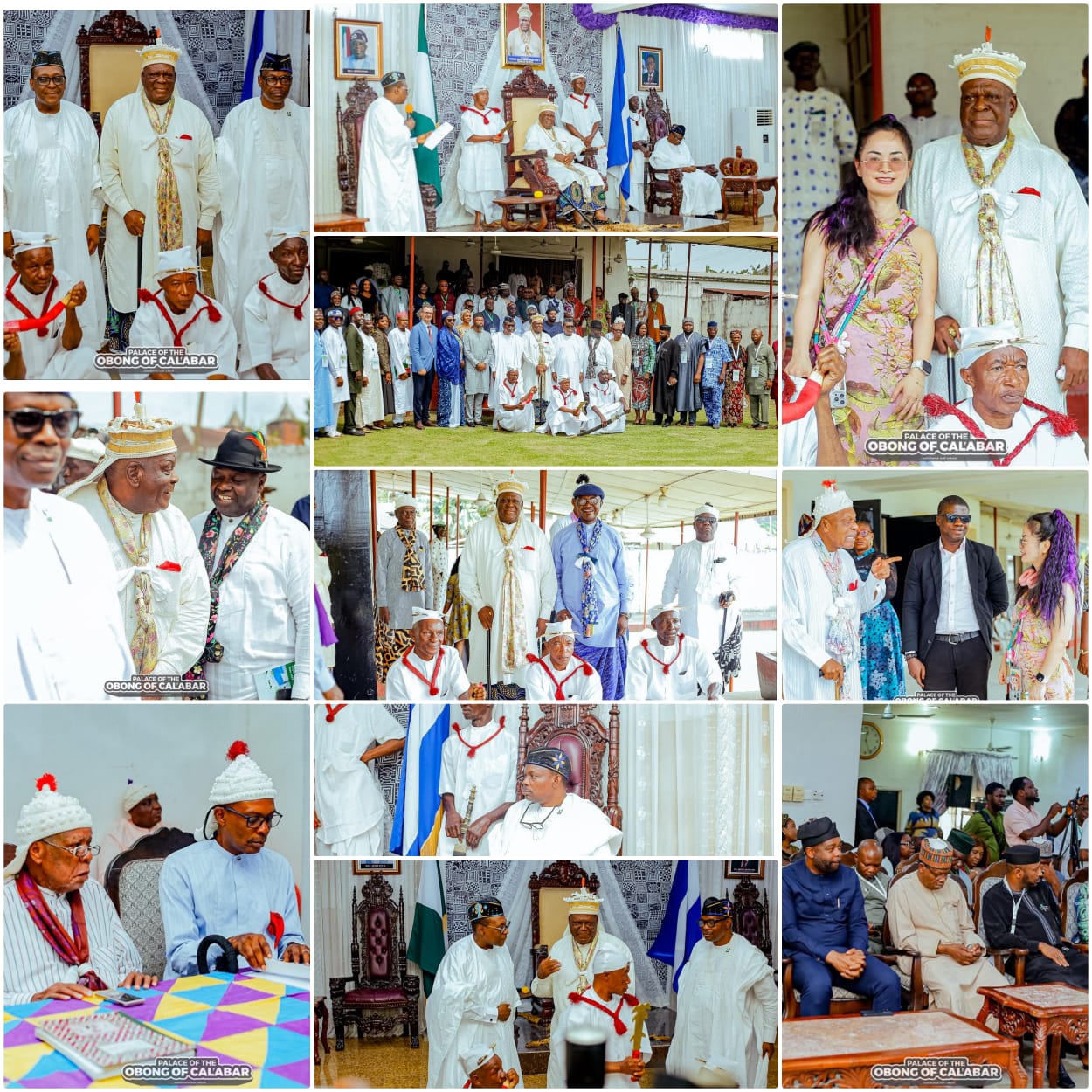
The Honourable Minister of Health and Social Welfare, Prof. Muhammad Ali Pate, in company of the Minister of State and his top management team, and Commissioners of Health from across the 36 states of the federation, on Friday paid a royal homage to His Eminence, Edidem Ekpo Okon Abasi Otu V, the Obong of Calabar and Patriarch of the Efik Eburutu Kingdom. The visit, steeped in tradition and marked by the usual courtesies befitting the revered throne, formed the concluding highlight of the 66th National Council on Health (NCH) Conference held in Calabar.
In the course of the audience granted by His Eminence, the Minister, speaking with evident appreciation, commended the Obong for his far-reaching contributions to public health development in Cross River State, particularly the gracious provision of land for the establishment of a primary health centre in Adiabo and many other health initiatives.
The Obong is known to have played a pivotal role in the completion and establishment of the Nigerian Navy Reference Hospital in Calabar, demonstrating the monarch’s commitment to the welfare and wellbeing of not only his people, but all citizens of Nigeria.
The Minister observed that at a time when government is intensifying efforts to strengthen primary healthcare and extend essential services to the grassroots, the intervention of traditional institutions remains invaluable. He noted that the Efik throne, under the distinguished leadership of His Eminence, has consistently supported causes that advance the health and social progress of the kingdom, thereby complementing national and state initiatives, and described the Obong as a ‘Champion’ of Health.
His Eminence, in his response, expressed delight at the Minister’s visit and extended his blessings to the entire delegation. He reaffirmed the readiness of the Efik Palace to continue working with the Federal Ministry of Health and the Cross River State Government in promoting health awareness, encouraging community participation, and supporting programmes that enhance the wellbeing of the people.
The homage, characterised by cultural warmth and mutual respect, provided an opportunity for deeper engagement between the Ministry and the traditional authority. It also underscored the significance the Federal Government places on forging strong partnerships with community leaders in the collective effort to improve health outcomes nationwide.
With this visit, the 65th National Council on Health Conference drew to a dignified close, bringing together policy deliberations, intergovernmental cooperation, and cultural diplomacy in a manner reminiscent of the classic traditions of national service.