


By Kelvin Obambon
Uyo –Value Rebirth and Empowerment Initiative (VREI), in partnership with the African Centre for Leadership, Strategy and Development (Centre LSD) with support from the Ford Foundation, has launched an initiative to combat Gender-Based Violence (GBV) and promote gender equality in Nigeria NEGROIDHAVEN can report.
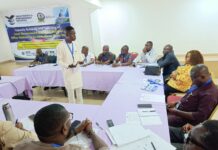
To drive the advocacy in the South South, VREI, on Monday, held a one-day Training of Trainers (ToT) Workshop for the Male Feminist Network (MFN) in Uyo, the Akwa Ibom State Capital.
The ToT workshop gathered community leaders, faith leaders, youth advocates, and gender champions to equip them with the knowledge and facilitation skills required to cascade training to the grassroots level, ensuring the message of non-violence and equality reaches all communities and institutions.
Amb. Pst. Edewor Egedegbe, the Executive Director of VREI, emphasized that the initiative goes beyond a typical project implementation. “The Male Feminist Network is more than a project; it is a movement that seeks to reshape mindsets, challenge harmful norms, and promote equity, fairness, and justice for all,” he stated.
Egedegbe highlighted the crucial role of the participants, noting that by engaging men as allies, they are actively breaking barriers to progress. He stressed the multiplier effect of the training, adding that “As trainers, each of you here represents a multiplier of change. This ToT will equip you with the knowledge, tools, and facilitation skills to cascade training to others at the grassroots.”
In his remarks, Dr. Samuel Victor, Secretary of the Uyo Traditional Rulers Council, praised the organizers for investing resources, analogizing the effort to a sound economic model, to train those who will, in turn, train others.
He expressed gratitude of the traditional institution to organizers of the workshop, saying “On behalf of the traditional institution, we say thank you, Male Feminist Network. Thank you, the leadership of this good organization. May God bless all of you.”
Ekemini Simon of The Mail Newspaper, speaking on behalf of the media, pledged support for the network’s mission, acknowledging that promoting gender equality is a shared, essential responsibility. “This issue is of interest to us,” Simon noted. “And we would carry out our work to stand with you as partners and to tell the stories that will always shape the narrative, the positive narrative of women.”
He also urged the network to consider protecting men’s rights in the process, ensuring a wholly just society for all genders.
Reeling out statistics on the global and national reality, Amb. Peace Edem, said that across the world, the status of women remains deeply precarious. “For centuries, women have been marginalized socially, economically, and politically in nearly every nation,” he said.
He declared that “Globally, one in every ten women lives in poverty. Women are less likely than men to have access to social protection, decent work, or financial services. In fact, 37% of women worldwide do not use the internet, that’s 259 million fewer women online than men. Women make up only 27.2% of parliamentarians globally, and at the current rate, the World Economic Forum estimates it will take 162 years to close the political empowerment gap and 169 years to close the economic participation gap.”
Edem who is one of the facilitators, recalled that “In 1922 men gained voting rights under the Clifford Constitution. Nigerian women, however, had to wait 57 long years until the 1979 Constitution to be recognized as equal citizens at the ballot box. That exclusion set the tone for decades of systemic disadvantage that continues to define our national landscape.”
He regretted that “Today, the story is still the same and, in some areas, worse. In rural Nigeria, women make up 60 to 79 percent of the workforce, yet men are five times more likely to own land.
“In leadership, only 4.7 percent of members of the House of Representatives and 2.7 percent of Senators are women among the lowest in the world. Compare that to Rwanda’s 61.25 percent, South Africa’s 46.23 percent, Senegal’s 46.06 percent, and Namibia’s 44.23 percent. Up to one in three Nigerian women has experienced some form of violence.
“Nigeria ranks 130th out of 146 countries on the Global Gender Gap Report (2023). Our maternal mortality rate stands at 512 deaths per 100,000 live births one of the highest in the world. And every year, thousands of girls drop out of school due to early marriage, teenage pregnancy, and poverty. These are not just numbers they are lives, families, and futures on the line.”