

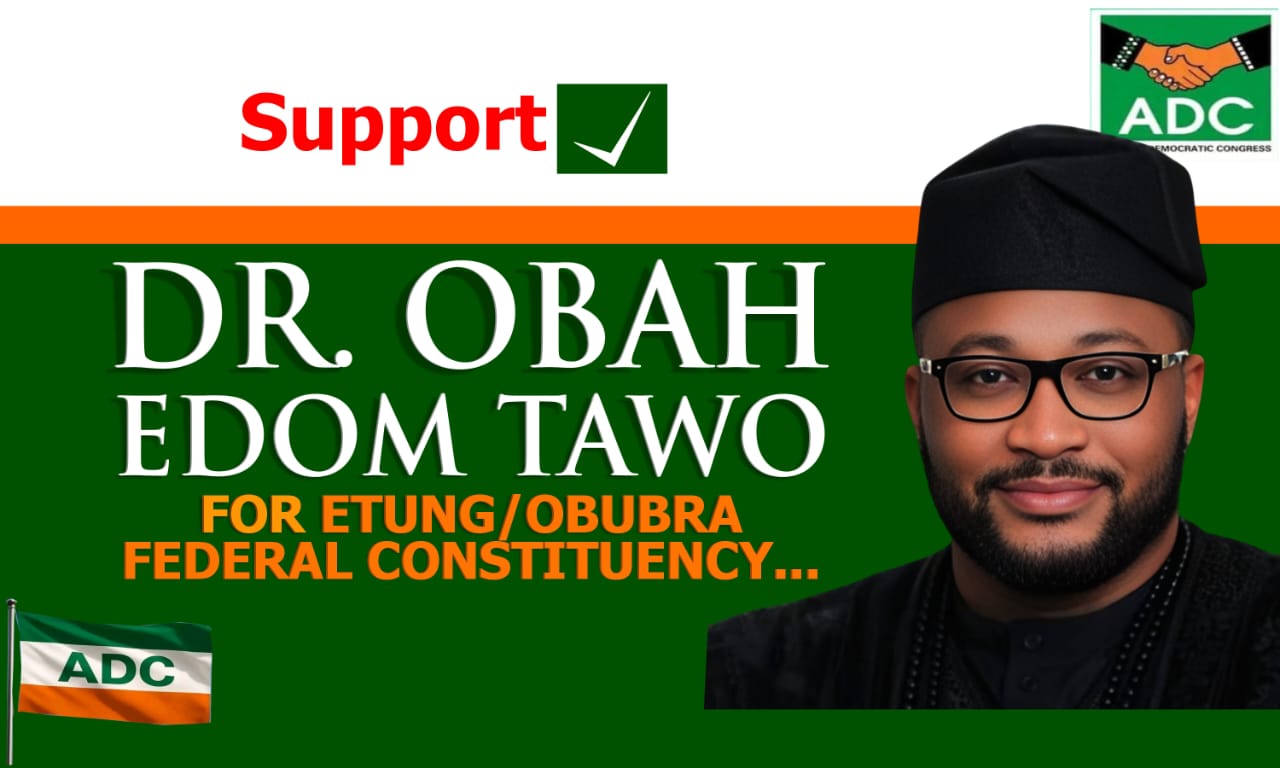
Dr. Obah Tawo, a House of Representatives aspirant for Etung/Obubra Federal Constituency on the platform of the African Democratic Congress (ADC), has outlined a development agenda anchored on road rehabilitation, job creation, and accountable leadership.
Speaking during an interview in Calabar, the Etung-born politician said poor road infrastructure remains the most pressing challenge confronting communities in the constituency, describing it as a long-neglected issue that continues to affect mobility and economic activities.
Tawo stated that his ambition is driven by the need to address these challenges through practical reforms that will improve infrastructure, stimulate local economies, and promote transparency in governance.
He lamented that roads leading into Etung have deteriorated to the point of being almost impassable, a situation he said has been widely reported and experienced by residents. According to him, poor road infrastructure has not only slowed down the movement of goods and services but has also placed a heavy burden on farmers who depend on accessible routes to transport their produce to markets.
Tawo emphasized that the consequences extend beyond commerce, noting that families often struggle to access healthcare due to the poor condition of roads. He stressed that in emergencies, the inability to quickly reach hospitals has resulted in avoidable suffering, reinforcing his position that road construction must be treated as a top priority.
Beyond infrastructure, he outlined a strategy to tackle youth unemployment by aligning industrialization with the natural resources available in the constituency. He pointed out that Etung and Obubra are rich in agricultural produce such as cocoa and cassava, yet the absence of processing industries has limited economic opportunities for young people.
He explained that by establishing systems to process raw materials into finished and semi finished goods, the constituency can unlock value chains that will generate employment and increase income. He cited products such as chocolate, starch, ethanol, and cosmetics as examples of what can be achieved if local resources are properly harnessed.
Speaking on what sets him apart from other candidates, Tawo highlighted what he described as presence, competence, and conscience. He said his upbringing within the community gives him a deep understanding of the challenges faced by residents, while his experience as a business executive and IT professional equips him with the skills needed to deliver practical solutions.
He also revealed that he has previously initiated efforts to establish a water production facility in the area, aimed at improving access to clean water. According to him, leadership must go beyond promises and reflect a genuine commitment to improving the living conditions of the people.
Addressing concerns about contesting under the African Democratic Congress in a political landscape dominated by larger parties, Tawo dismissed the perceived disadvantage, arguing that established parties have failed to meet the expectations of Nigerians. He maintained that voters are increasingly aware and ready to support credible alternatives that prioritize their needs.
He further outlined plans to ensure transparency and accountability in governance, including the creation of a digital constituency register that will track all projects, contracts, and implementations. He said this system will be accessible to the public and will allow residents to monitor progress and verify completed projects.
In addition, he proposed the introduction of community based verification systems, where locals will play a role in confirming the execution of projects in areas such as healthcare, road construction, electrification, and industrial development. He said this approach will ensure that governance remains people centered and responsive.
On legislative priorities, Tawo listed road development, improved healthcare access, and agro industrialization as key focus areas. He pledged to expand medical outreach programs, particularly for women and children, while also advocating for policies that will support large scale agricultural processing within the constituency.
He also spoke on the need to attract federal projects and investments, stating that he is prepared to build strategic alliances across party lines to deliver development to his people. According to him, governance should not be limited by political affiliation but driven by the desire to achieve tangible results.
Tawo stressed that his mandate is a contract with the people, one that requires him to deliver on his promises or be held accountable. He reminded constituents that they hold the ultimate power to demand performance and make decisions based on results.
He expressed confidence in the future of the African Democratic Congress, acknowledging current challenges but describing them as temporary. He urged supporters to remain patient, assuring that the party will emerge stronger and more united.
Looking ahead, he said measurable outcomes within his first three years will include significant improvements in road infrastructure, expanded medical outreach, and the introduction of industrial education programs tied to agriculture. He concluded by reaffirming his commitment to building a constituency where development is visible, inclusive, and sustainable.