


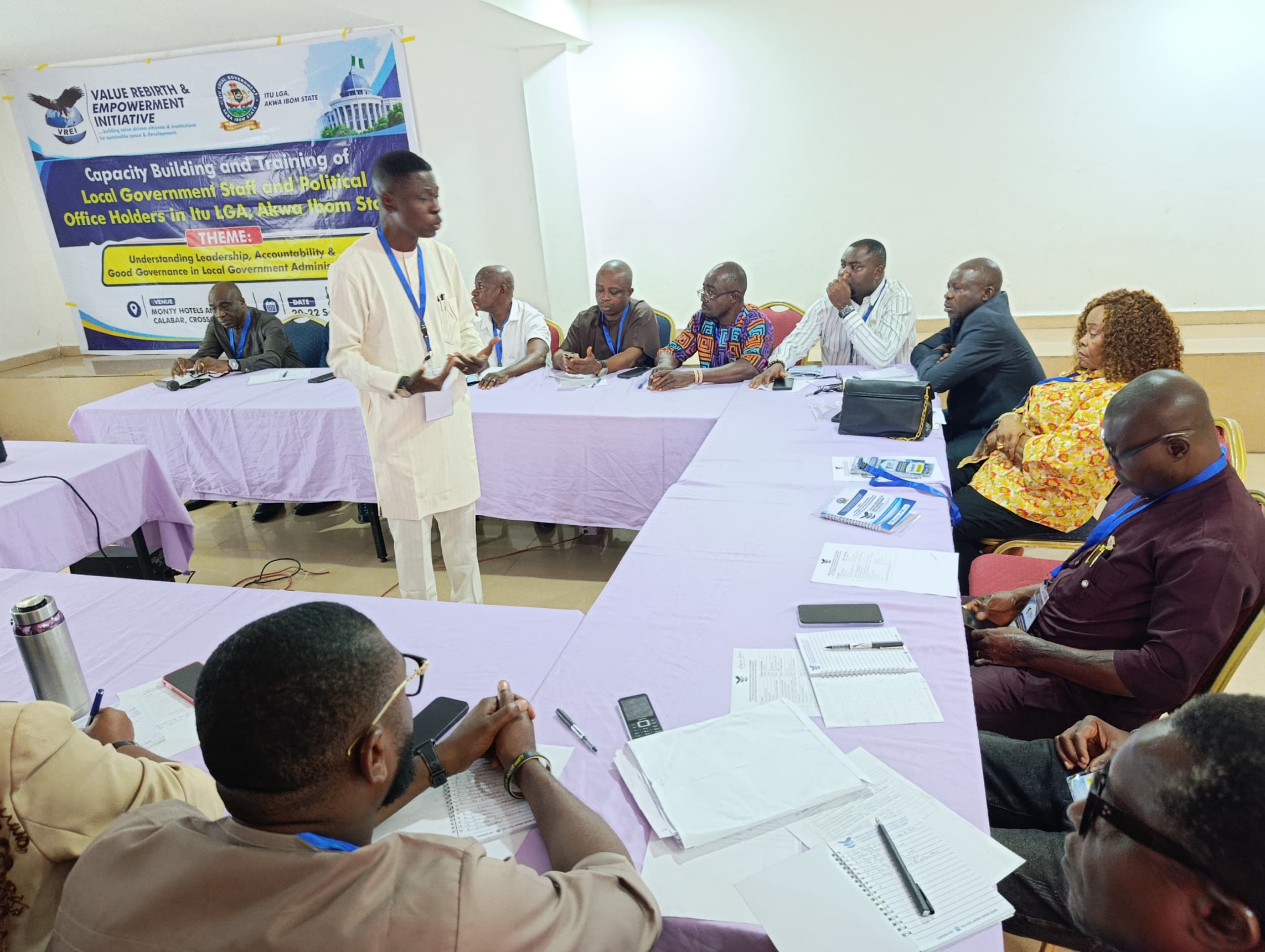
The Value Rebirth and Empowerment Initiative has trained staff and political office holders in Itu Local Government Area of Akwa Ibom State on leadership, accountability, and good governance in local government administration.
The three-day capacity building programme, held at Monty Hotels and Suites, Calabar, Cross River State, from September 20 to 22, 2026, was organised under the theme, “Understanding Leadership, Accountability & Good Governance in Local Government Administration.”
The Executive Director of VREI, Pst. Edewor Egedegbe, said the training was designed to equip the executive arm of the council with the skills required to deliver on the Chairman’s development blueprint.
Egedegbe defined leadership as influence, citing Myles Munroe and John Maxwell, and drew a distinction between a leader and a person in a leadership position.
According to him, while a leader places a high value on people and commits resources to developing them, a person in position places a high value on position and demands respect because of their title.
“The best leaders help others succeed. The best leaders lead, empower and get out of the way,” he said.
He outlined three capabilities leaders must demonstrate: the head (intelligence and strategy), the heart (empathy and people), and the guts (courage to take bold decisions).
He also identified six leadership styles—autocratic, democratic, laissez-faire, transformational, transactional, and servant leadership—urging participants to adapt their style to the situation, team, and goals.
On governance, Egedegbe defined it as the system of rules, practices, and processes that ensures an organisation is run fairly, transparently, and accountably, listing accountability, transparency, integrity, and participation as its four pillars.
He presented the Leadership Triangle—Leadership + Governance + Execution = Sustainable Impact—warning that vision without execution is hallucination, governance without execution is empty promises, and execution without leadership is aimless.
“Good governance is the art of putting leadership vision into execution that serves the people,” he said.
In a separate presentation, Professor Andrew Agboro of the University of Benin, a resource mobilisation expert, trained the executive arm on strategic resource mobilisation for sustainable development.
Agboro distinguished between revenue collection and resource mobilisation, describing collection as the final operational step while mobilisation involves policy design, strategic partnerships, asset mapping, and economic enablement.
He commended the Itu LGA Chairman for adopting a Public-Private Partnership model for revenue collection, saying it reduces overheads and frees the executive to focus on core governance.
The training ended with three action items: setting up an Executive-Contractor Liaison Committee, a sub-committee to review and modernise Itu LGA economic bye-laws, and the formulation of the Itu LGA Alternative Revenue Mapping framework.