

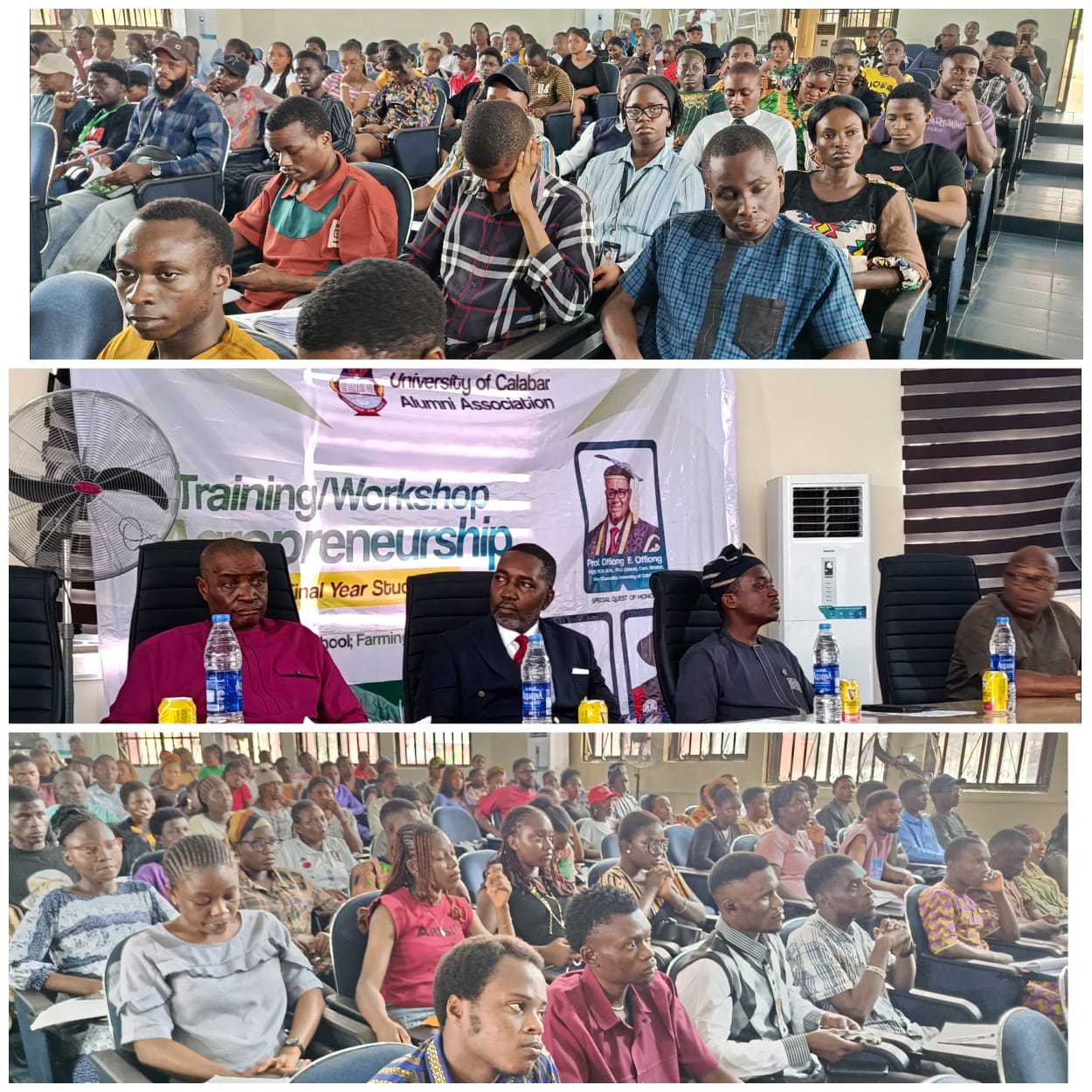
CALABAR — The University of Calabar Alumni Association has trained about 1,000 final-year students in agropreneurship, teaching them to farm without land ownership using sack bags and backyard spaces.
The training, themed “Life After School: Farming Without Land,” was held at the University of Calabar on Thursday.
It was designed to provide graduating students with an alternative source of income amid a harsh labour market.
Speaking at the event, the National Vice President 1 of the UNICAL Alumni Association Worldwide, Mrs. Chinyere Sani, said the training was informed by the reality of graduate unemployment in Nigeria.
She said, “We know that there are no jobs in the country. Jobs are not guaranteed. So with this training now, as they are about to graduate from school, they are able to fend for themselves until they get the opportunity of getting something to do with the course they have studied in the university.”
Mrs. Sani described the training as a “Plan B” for the students, noting that the current economy requires everyone to seek a second means of income.
She said, “Apart from their main course of study, they can take care of themselves. You know, as the economy is now, everybody is trying to look for a second means of income.”
…Farming without land
The workshop focused on innovative agricultural methods that do not require large tracts of land—a major barrier for young graduates.
The sponsor of the programme, Emmanuel Asido, a legal practitioner and alumnus of the university, said participants were being taught how to venture into agriculture with minimal investment.
Asido said, “Therein lies the advantage in this training. Because participants are able to learn how to get involved in agriculture with very little investment in it. And so it’s not the traditional type of agriculture where acquisition of large tracts of land has to be done first, with all the challenges with the land tenure system.”
He said a graduate living anywhere can start farming at the back of their house using abandoned sack bags and produce enough to feed themselves and more.
He said, “Somebody who is living somewhere can just, at the back of his house, with some old or abandoned sack bags, start farming. And produce what can feed much more than he or herself.”
Asido noted that the training is structured to help students acquire knowledge first, then practicalise it before scaling up.
He added that at the point of scaling up to a large agricultural concern, there are various opportunities within the Alumni Association for venture capital.
…Personal testimony
Asido, who sponsored the training, shared his personal experience in agribusiness.
He revealed that he has ventured into poultry farming, as well as the planting of plantain and cassava, describing both as “very rewarding.”
He said, “I’ve also ventured into poultry business. It was also very rewarding. I’ve also gone into planting of crops. Plantain and cassava is also very rewarding. But I want to learn more. Because the more you learn, the more confident you are. And the better equipped you are to scale things up to something larger.”
…Practical skills vs theory
The resource person, Dr. Chris Nwagboso, Managing Director/Chief Executive Officer of Kritznely Farms Ltd., emphasised the need for graduates to become producers rather than consumers.
Nwagboso challenged the students to bridge the gap between theory and practice, using their hands and knowledge to create wealth.
He said, “You have to go very smart, very honest. You can produce all those things. Through one of the things we are going to do later today, you will know how to produce all those things that you rush in the market to look for. You can produce them.”
He urged the students to put the knowledge they acquire into practice, noting that the essence of the training was to bring knowledge to them while they provide the practice.
He said, “God has given you the knowledge. You have to put that knowledge into practice. Use your brain. Use your hands. Your hands and your breath are very powerful.”
…No capacity to settle students
While the alumni association is committed to equipping students, Mrs. Sani was candid about the association’s limitations.
She stated that the alumni does not have the capacity to settle students financially after the training.
She said, “The alumni doesn’t have that kind of capacity. The children don’t even need to be settled by the alumni. Because after the training, they can discover their hidden talents and make provision for what they would like to do with the training that they have received today. We will encourage them in some way.”