


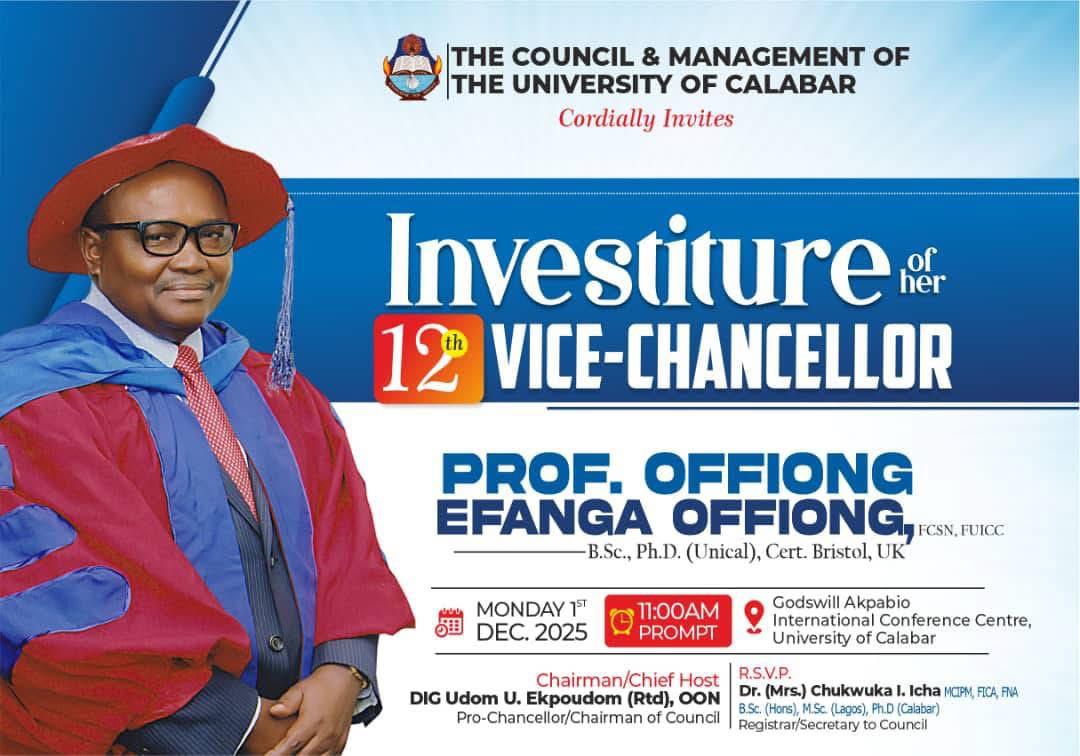
When the University of Calabar gathers on Monday, December 1, 2025, to formally invest Prof. Offiong Effanga Offiong as its 12th Vice-Chancellor, the event will be far more than a change of administrative leadership. It will be a rare fusion of ceremony, academic culture, institutional tradition, and the symbolic renewal of the university’s identity.
At first glance, a VC investiture may appear to be a strictly protocol-driven academic ritual. Yet, beneath the regalia, the procession, and the formal speeches lies a deeper story—one that reflects how universities incluing UNICAL reimagine themselves, assert continuity, and reaffirm the values that shape their intellectual communities.
The Anatomy of an Academic Ritual
Investiture ceremonies in universities draw inspiration from centuries-old European academic traditions, where knowledge institutions marked leadership transitions with elaborate rites. UNICAL, like most Nigerian universities, preserves this lineage.
Guests today will see:
* An academic procession—a colourful parade of senior academics, visiting scholars, governing council members, and university leadership.
* Academic regalia—the symbolic attire that reflects rank, discipline, and institutional belonging.
* The formal handover of instruments of authority, often including the university mace.
* Oaths, citations, and ceremonial declarations that publicly bind the new Vice-Chancellor to the institution’s mission.
Why Investiture Still Matters in University Culture
A Vice-Chancellor is not merely a chief administrator. He—or she—is the symbolic and intellectual face of the university.
The UNICAL Context: A Ceremony Shaped by History and Hope
As Prof. Offiong takes office, UNICAL finds itself at a defining moment. The institution has navigated years of academic, infrastructural, and administrative challenges, while also recording notable advancements in research visibility, accreditation, and student enrolment.
This investiture therefore symbolizes:
*Academic renewal
*Administrative recalibration
*New energy for long-term institutional reforms
For staff and students, it signals the beginning of a new chapter—one that will demand fresh leadership perspectives on academic quality, campus security, research development, staff welfare, student experience and community relations.
The Role of Community and Public Participation
The University of Calabar has invited not only internal stakeholders but also the general public to witness the ceremony. This inclusion reflects a broader reality:
Universities do not exist in isolation. They function within political, cultural, economic, and social ecosystems.
From the announcements to the formal entry of the Pro-Chancellor, from the robe worn by the VC to the presentation of the mace, every act is carefully choreographed.
Each element carries subtle messages about:
* Order
* Authority
* Scholarship
* Continuity.
These elements collectively reaffirm the university’s place in the wider cultural fabric of the Nigerian society.
What Happens After the Ceremony
While the day itself will be marked by celebration and ceremony, the real work begins immediately after:
* policy formulation
* team building
* strategic planning
* stakeholder engagement
* institutional reforms
Implying an investiture is a moment; leadership is the journey.
For Prof. Offiong and the University of Calabar, the investiture is the overture to a larger story—one that will unfold over the next five years through decisions, achievements, and institutional transformation.
As the UNICAL community gathers at the Godswill Akpabio International Conference Centre, they will not only witness a leadership installation but also participate in a reaffirmation of the university’s enduring spirit: to research, to teach, to learn, to lead, and to grow.
May Prof. Offiong Effanga Offiong succeed. May the fortunes of the University of Calabar soar in his time.