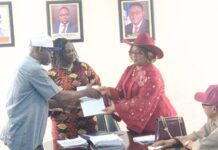



Governor Bassey Otu of Cross River State on Monday declared that the state would no longer tolerate what he described as injustices surrounding the disputed oil wells, insisting that Cross River’s rights must be recognised and protected.
Otu made the remarks at the Margaret Ekpo International Airport, Calabar, during a reception organised to welcome him back to the state following engagements over the contentious oil wells matter.
“There comes a time in the life of a people when our right must be justified and carried. People cannot be cheated forever,” the governor said.
Referring to the ceding of Bakassi Peninsula to Cameroon in 2008 following the International Court of Justice ruling, Otu argued that the decision was taken in the interest of national peace and not as a basis for Cross River State to lose its economic assets.
“The ceding of part of Bakassi was for peace for Nigeria; it was not for Cross River State to come and lose its oil wells,” he stated.
The governor added, “Enough of nonsense. Cross River State cannot take rubbish anymore. What is our right is our right. We are full-fledged Nigerians. Nobody can deny us.”
The oil wells dispute has remained a longstanding issue between Cross River and neighbouring oil-producing states following boundary adjustments and legal pronouncements that affected derivation revenue allocations.
The controversy intensified after the Supreme Court, in a series of decisions beginning in 2012, held that Cross River State was no longer entitled to oil wells located in the Bakassi Peninsula following its cession to Cameroon. The apex court ruled that with the loss of Bakassi territory, Cross River ceased to qualify as a littoral state for the purpose of offshore oil revenue derivation under Section 162(2) of the 1999 Constitution.
In subsequent clarifications and related judgments involving neighbouring Akwa Ibom State, the Supreme Court affirmed the delineation of maritime boundaries and upheld revenue allocations based on the adjusted territorial status. The rulings effectively removed Cross River from the list of oil-producing littoral states entitled to the 13 per cent derivation from offshore oil wells tied to the disputed areas.
The decisions significantly altered Cross River’s revenue profile, triggering political and legal debates that have persisted over the years regarding equity, federalism, and resource control.
Otu’s remarks signal a firmer political tone as the state continues consultations and engagements aimed at addressing the matter.
While not disclosing specific details of his recent engagements, the governor emphasised that the state was prepared to pursue its claims through legitimate and lawful means.
He also linked the oil wells issue to broader developmental challenges confronting the state, including poor road infrastructure, maternal health risks, and youth unemployment.
“Pregnant women should be able to travel from Calabar to Biase without losing their pregnancy,” he said, lamenting the condition of some roads in the state.
The governor further expressed concern over rising unemployment and economic hardship, noting that many young people were struggling to meet basic needs.
“Our unemployed youth who are suffering all over the place, many that cannot eat even once a day, it is time for us to be a real state,” Otu said.
He described Cross River people as hardworking and capable, adding that the state possessed the human capacity required to contribute meaningfully to national development.
“We have human capacity in all respect and ramifications. Any role you want to engage us in Nigeria, we are ready for it,” he added.
Calling for unity among residents, Otu urged citizens to remain resolute and optimistic about what he described as a “new dawn” for the state.
“Cross River change must go forward. It is forward ever, backward never,” he declared.
The reception at the airport drew political supporters and government officials, who gathered to welcome the governor back to the state.
The oil wells dispute has significant fiscal implications for Cross River State, particularly in relation to derivation revenue allocations from the Federation Account. Observers say the governor’s renewed rhetoric underscores the administration’s determination to revisit the issue within constitutional and institutional frameworks.