

In an age where many public figures are remembered only for politics, power, or positions once occupied, Rt. Hon. Orok Otu Duke is steadily carving a different path, one written in ink, memory, culture, and history.
Known by many as a passionate intellectual and an unapologetic lover of books, Duke has continued to build an enduring literary legacy through consistent writing and publication. His growing body of work has now earned visibility across major global platforms, with his recent books available on Google, Amazon, Yahoo, Kindle, and leading bookstores around the world. Both digital Kindle editions and hard copies are now accessible online to readers globally.
To literary enthusiasts and historians, this is more than just another round of publications. It is the emergence of a Cross River voice determined to preserve history, document human experiences, and contribute meaningfully to global knowledge.
Speaking with journalists recently in Calabar, Duke explained that his motivation goes beyond personal accomplishment.
“I am contributing to knowledge and want my name to be written in the sands of time through my contributions,” he stated.
That philosophy appears deeply reflected in his latest five books, which were officially released worldwide on April 30, 2026. Each carries themes of history, identity, survival, culture, and human emotions.
Among the most emotionally gripping of the books is:
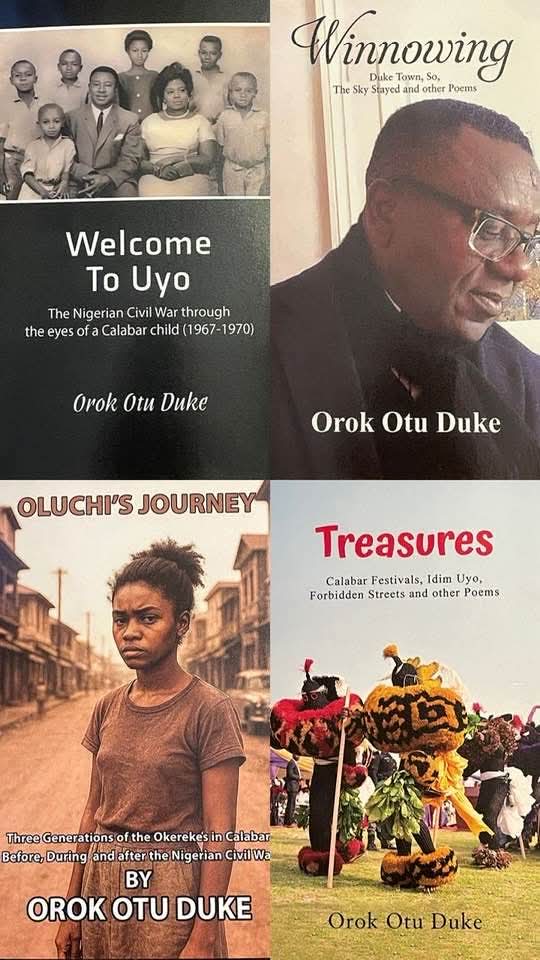
✓ Welcome to Uyo – The Nigerian Civil War Through the Eyes of a Calabar Child (1967–1970).
The book takes readers into the painful realities of the Nigerian Civil War through the personal experiences of Duke as a child caught in the turbulence of conflict. Through simple but vivid storytelling, he documents the trauma, displacement, fear, and uncertainty faced by minorities in Eastern Nigeria during the war years.
Rather than merely recounting historical events, the book humanizes the conflict, offering readers an intimate glimpse into how families struggled for survival amid chaos. It is both a memoir and a historical contribution aimed at preserving memories that could easily fade with time.
Duke also explores the depth of human emotions and social reflections through poetry in Winnowing – Duke Town, So, The Stayed and Other Poems and Treasures, a collection of poems.
These works reveal his reflective side, blending culture, philosophy, memory, and everyday realities into carefully crafted verses. The poems echo themes of identity, belonging, societal values, and the changing face of African communities.
For readers familiar with Calabar’s rich cultural heritage, the poems offer both nostalgia and introspection.
Another remarkable publication is Oluchi’s Journey, a sweeping narrative that follows three generations of the Okereke family in Calabar before, during, and after the Nigerian Civil War.
The novel captures the complexities of family, survival, resilience, and changing social realities. At the center of the story is Oluchi, a character portrayed as having lived “on the wild side of life,” navigating difficult circumstances shaped by history and personal choices.
The book combines fiction with historical realities, creating a compelling portrait of a society transformed by conflict and time.
In Calabar Modern Stories, Duke turns his attention to contemporary social realities, weaving together stories influenced by culture, politics, and everyday human experiences.
The collection attempts to preserve both spoken and unspoken narratives embedded within society, stories shaped by tradition, leadership, struggle, and modern urban life.
The work reflects the evolving identity of Calabar and serves as a literary mirror of societal practices often overlooked or understated.
Beyond these latest releases, Duke’s earlier literary works also continue to attract readership and critical attention. His previous books include Clementines, Sentinels, Dances on the Plains, My Song, and Ellipses — publications that further demonstrate his long-standing commitment to storytelling, poetry, history, and cultural documentation.
For many observers, Duke’s writings represent more than literary accomplishments. They contributes to documentation, cultural preservation, and intellectual discourse.
At a time when many historical experiences risk being forgotten, especially among younger generations, these books stand as reminders of the importance of storytelling and record keeping.
His publications also reinforce the growing influence of Nigerian authors in global literary spaces, proving that local stories can resonate far beyond their immediate environment.