


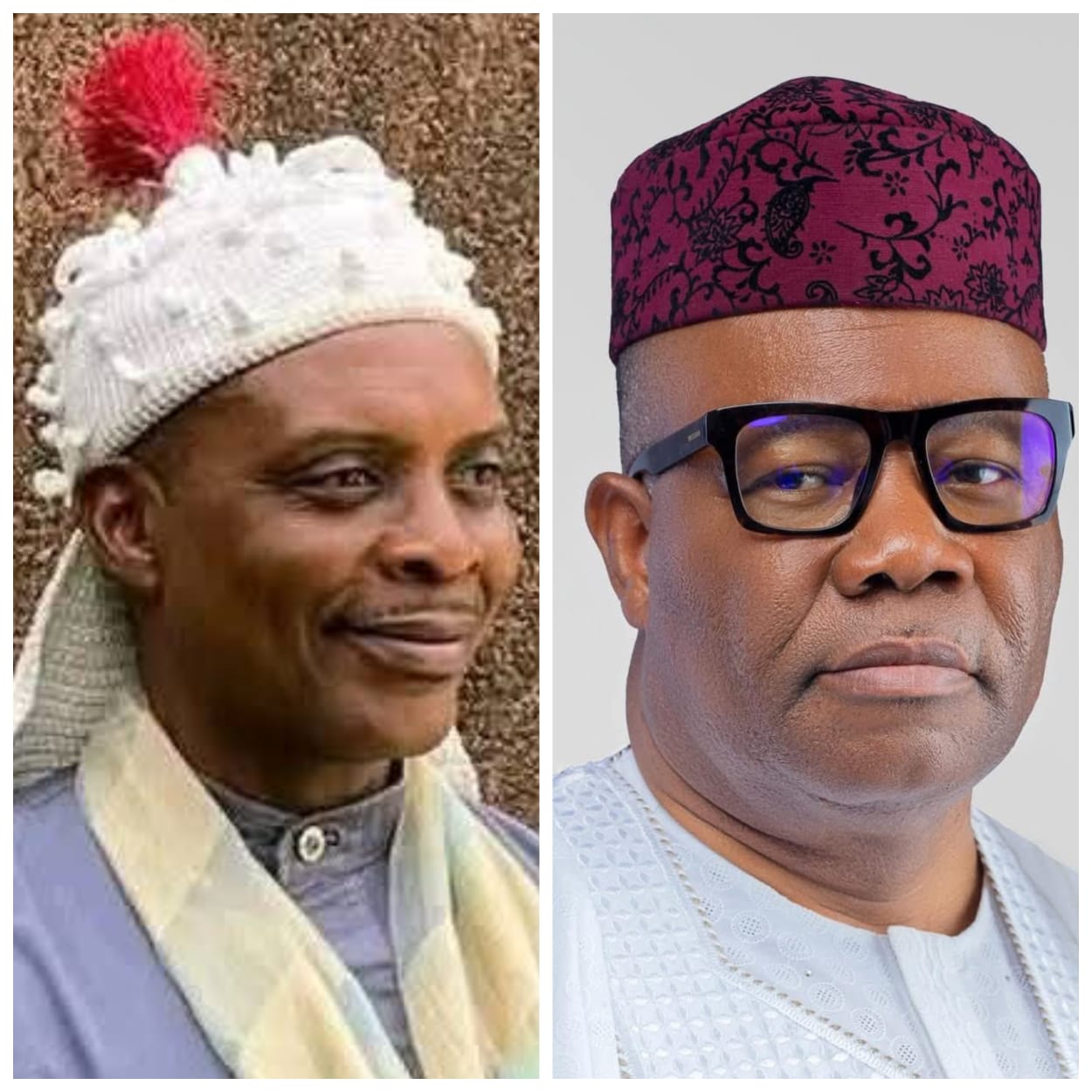
Etubom (Arc.) Abàsi Eyo Ndem (also known as Abasi Eyo-Ndem IV or Bassey Eyo Ndem) is a distinguished architect, Efik traditional ruler, and cultural custodian.
He is the Etubom of the Ntiero Edem Efiom Ekpo Royal House (sometimes referred to as Abasi Ntiero Royal House) and a member of the Etuboms’ Traditional Council in the Palace of the Obong of Calabar. He was formally inducted into the council in 2019 by His Eminence Edidem Ekpo Okon Abasi Otu V, the Obong of Calabar. As an Etubom, he is one of the kingmakers of the Efik Kingdom and eligible, under traditional rules, to ascend the throne of the Obong of Calabar when the position falls to his house or area.
Born to the late Etubom Eyo Abasi Eyo-Ndem—a professor of sociology and anthropology, former Deputy Vice-Chancellor of the University of Jos, and one-time acting Vice-Chancellor of the University of Cross River State (now University of Uyo)—and Mrs. Asari Eyo Ndem, he received his early education in Nsukka and later in Zambia due to the Nigerian Civil War. He completed secondary school at Baptist High School, Jos, and studied architecture at the University of Jos, earning his MSc in 1987. While a student he won first prize in a UNESCO international architecture competition among entries from 67 countries, which earned him participation in the Tsukuba International University Expo in Japan in 1985. He began his professional career in Lagos with Sheltarch Associates.
Though he neither lived nor schooled in Calabar in his youth, he has immersed himself deeply in Efik language, history, rituals, and culture as an adult. He is an Ekpe Iboku titleholder, holds the title of Obong Mbakara in the ancient Asibong Ekondo lodge, has been a principal driver of the annual Nyoro Ekpe festival, and is noted for his knowledge of Nsibidi. He has also served as Commissioner for Lands in Cross River State and is a consistent advocate for the constitutional recognition and strengthening of traditional institutions in Nigeria.
A respected voice within the Efik Eburutu Kingdom and a mentor to younger generations, Etubom (Arc.) Abàsi Eyo Ndem combines professional expertise in architecture with a profound commitment to preserving and evolving Efik heritage.
In this brief interview, Ndem articulated his perspective to a recent opinion credited to HE Senate President Godswill Akpabio of the 10th National Assembly.
NEGROIDHAVEN: What is your comment on the Senate President’s assertion that 40% of Cross River State’s population are from Akwa Ibom?
Ndem: Well, His Excellency, Distinguished Senator Godswill Akpabio, is the number three citizen of Nigeria. He certainly has access to information and statistics that laymen like me may not have. So, if he says that 40% of Cross Riverians are Akwa Ibomites, I am inclined to believe that he knows something I do not. His assertion should therefore be taken seriously.
In the speech I listened to, he also spoke of extraordinary and uncommon love. I would therefore urge him to back up those words with action by ensuring that 40% of Akwa Ibom State’s federal allocation is transferred to Cross River State to help cater for the Akwa Ibom indigenes resident here.
Last month, Akwa Ibom reportedly received approximately ₦80 billion, compared with less than ₦20 billion received by Cross River. If our distinguished Senate President could demonstrate this uncommon love by facilitating the transfer of about ₦32 billion—40% of Akwa Ibom’s allocation—we would be eternally grateful.
Let us not forget that 40% of a state’s population is a substantial number. It places considerable pressure on infrastructure, schools, hospitals, electricity and other public services. Yet, despite this pressure from those whom the Senate President claims constitute 40% of our population, we continue to welcome our Akwa Ibom brothers and sisters.
Indeed, some of them work and earn their living in Cross River but carry the resources to Akwa Ibom to build their homes. Nevertheless, we have not resorted to the kind of xenophobic attacks witnessed in South Africa. No! We embrace them, protect them and continue to provide opportunities for them to live peacefully and harmoniously in Cross River State.
That, to me, is what uncommon love should look like.
NEGROIDHAVEN: What about the implied assertion that 40% of the workforce in Cross River State, including village heads, are Akwa Ibom indigenes?
Ndem: Yes, I have heard similar assertions in some quarters. But I would simply remind people that, in my view, they continue to maintain with us a relationship not unlike that of settlers, migrant or indentured workers, refugees, and dependants that has existed for centuries. It is a relationship that has endured for over 400 years, and I see no reason why this symbiotic relationship should not continue into the future.
Let us not forget that Cross River State has 18 local government areas. Akamkpa Local Government Area alone, for instance, is about the same size of the entire state of Akwa Ibom. That should give some perspective on the size and capacity of our state, and the landmass and extra population our governor, HE Senator Bassey Edet Otu, has to cater for with such meagre resources.
So, we are reciprocating the uncommon love declared verbally by Senator Akpabio by practically opening our arms and embracing our Akwa Ibom brothers and sisters who have willingly chosen to leave their own state, and come to live and enjoy the serene, humane, land of milk and honey that we call Cross River State.
On the issue of village heads, I commend the Senate President for emphasising the importance of educating people and making them aware of the facts.
Let me therefore seize this opportunity to educate the public on an important aspect of our traditional institutions.
The system of village heads, as we know it today, is largely an alien, colonial administrative construct, imposed and subsequently adopted by the Nigerian State. The Efik people, however, have their own sophisticated traditional system, comprising Etubom, Ọnọitem, Otueköng, Ibuot Ufök and Ibuot Obio. These traditional institutions predate, and operate independently of, the colonial system of warrant chiefs and village heads, which the British used as instruments of political administration and control.
I would have been shocked if the Senate President had said that an Etubom from Cross River State, goes to Idung—an ancestral home— in Ikot Ekpene. What an abomination!
Let me make another important distinction: Efik royalty is founded on genealogical and established blue bloodlines, with no room for arbitrary substitution. Village heads, on the other hand, are political or administrative appointments, often recognised through government-issued certificates. Consequently, a person from virtually anywhere may be appointed a village head, especially if they have powerful friends in the state or federal government.
We must therefore be careful not to confuse a government-recognised administrative position with the traditional institutions and hereditary structures of the Efik people.
NEGROIDHAVEN: Thank you. Now, what about the statement that Cross River State is landlocked and is not a littoral state?
Ndem: Well, I would say that the Senate President may not be fully aware that the Nigerian Navy and the National Hydrographic Agency completed a major hydrographic, geophysical and geotechnical mapping exercise around the Bakassi Peninsula and the Calabar–Bakassi maritime corridor in 2025.
The exercise produced modern Electronic Navigational Charts (ENCs), including charts covering Jamestown, Queenstown, the area towards Ikot Abasi, and the Port of Calabar. These charts have been validated by the International Centre for Electronic Navigational Charts (IC-ENC), to replace older legacy charts dating back to 1903.
These internationally validated studies have proven conclusively that Cross River was wrongly misrepresented as a non littoral state 20 years ago, using some maps that are over 120 years old.
We have been vindicated and should not continue to rely uncritically on outdated maps when modern hydrographic surveys and internationally recognised technical standards are available.
Modern technology should help resolve these questions on the basis of hard incontrovertible evidence, not political convenience.
The same principle applies to the broader question of how Africa has been represented on maps over the years and the recent vote by the United Nations to correct that exploitative anomaly.
Furthermore, the 2025 hydrographic charting exercise has uncovered billions of dollars worth of new gas, oil and other mineral or biological resources which are due for equitable derivation sharing between Cross River, Akwa Ibom states and the federal government.
Once again, I would urge our distinguished Senate President to demonstrate his uncommon love in practical terms by ensuring that Cross River receives every share of revenue and resources to which it is entitled.
And if his assertion that 40% of our population comes from Akwa Ibom is to be taken seriously, he could also reciprocate our uncommon love by ensuring that 40% of Akwa Iboms share in the newly uncovered deposits are added to Cross Rivers portion when the assets are shared.
NEGROIDHAVEN: Finally, do you have any message for the Senate President and the people of Akwa Ibom State?
Ndem: We thank our dear Senate President for his kind words and for reminding us of the uncommon love that exists between our two neighbouring states.
We look forward to being invited to the 40th anniversary celebration of Akwa Ibom State, where, hopefully, Cross Riverians will be recognised and celebrated for their hospitality, generosity and kindness towards our neighbours over the centuries.
After all, uncommon love should not only be spoken about. It should also be demonstrated.
And if 40% is indeed the figure, then we shall be happy to see 40% of the corresponding goodwill reflected in practical terms before the 40th anniversary celebrations!