



History came full circle on Wednesday as the Efik Eburutu Kingdom in Calabar formally inducted 85 diasporans of African descent into its royal fold—reuniting descendants of enslaved Africans with their ancestral homeland after nearly four centuries NEGROIDHAVEN has confirmed.
The emotional ceremony, presided over by His Eminence, Edidem Ekpo Okon Abasi Otu V, the Obong of Calabar, marked a symbolic homecoming for Afro-descendants from Trinidad and Tobago, Grenada, Jamaica, and St. Martin, who traced their lineage to the Efik coast—one of the major departure points during the transatlantic slave trade.
Speaking with NEGROIDHAVEN, Otuekong (Sir) Francis Edet, Spokesperson of the Palace of the Obong of Calabar, described the event as “a beautiful thing” that restores dignity to those whose forebears were taken away as slaves.
“The King has accepted them as members of the Efik Kingdom. They’ve been shared out into different royal houses and given Efik names based on those families,” Edet said. “Now, they are no longer strangers. They are indigenes of the Efik Kingdom.”
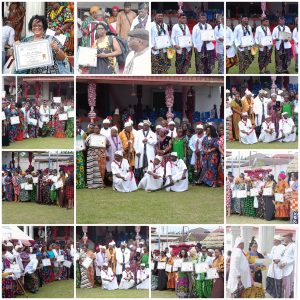
He recounted how one of the diasporans, moved to tears, appealed to the Obong to extend the gesture by encouraging more descendants abroad to return home and reconnect with their roots.
“She wept as she spoke about the suffering of her grandparents who were sold into slavery,” Edet recalled. “Today, their descendants have been welcomed back home. It is a thing of joy for us all.”
Among the returnees was an 86-year-old woman from Trinidad, who journeyed to Calabar to see the land her ancestors were taken from. Others expressed excitement about investing in the local economy and contributing to agricultural and cultural development projects.
The event, which featured prayers, music, and traditional rites, was coordinated in collaboration with the Cross River State Diaspora Commission (CRIDCOM) and the Global United Christian Congress of Africa and the Diaspora (GUCCAD).
Otu Okor, Director-General of CRIDCOM, described the induction as both homecoming and investment-driven.
“Many of them are entrepreneurs and investors. This reconnection will open opportunities for partnerships, job creation, and economic growth,” he said.
For Reverend Nneka Nwosu, Co-founder of GUCCAD, the ceremony signifies a spiritual and cultural rebirth.
“This is a seed in the ground. We will continue to build upon this foundation at both the diaspora and state levels,” she noted.
As the sun set over Calabar, the newly inducted Efik descendants bore not only new names but a renewed identity — one rooted in reconciliation, belonging, and the shared promise of a future that heals the past.